Structural Drying and Dehumidification in Rosemount, MN
Structural drying is done to meter readings in any home, so the equipment is placed by the wet areas, adjusted every day and removed only when the framing and subfloor read dry.
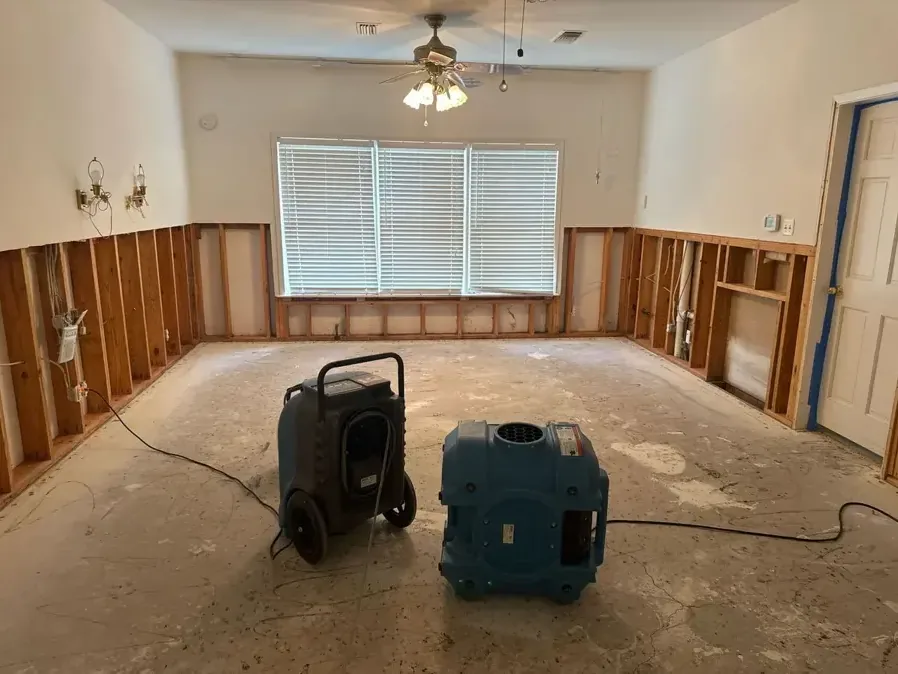
First steps for structural drying and dehumidification
- Map the wet areasMeters and imaging mark every wet surface and cavity.
- Place the equipmentAir movers and dehumidifiers go where the readings call for them.
- Read it every dayMoisture content is logged and equipment is adjusted.
- Release the structureMachines leave only when readings match normal.
How structural drying and dehumidification is handled
- 01Assess
Map
Meters mark wet surfaces and cavities.
- 02Remove
Place
Equipment goes where readings call for it.
- 03Dry
Read
Moisture is logged every day.
- 04Verify
Release
Machines leave when areas test dry.
The drying goal: wet materials read within 2 to 4 points of a dry reference material in the same building. Equipment leaves on readings, not on a schedule.
What does structural drying and dehumidification cost in Rosemount, MN?
Structural drying costs $1,000 to $2,500 for a small area at Class 1 to 2 and $2,500 to $5,500 for a full room or level. A Class 4 basement runs $4,500 to $8,500.
- Few machines
- Short equipment run
- Daily readings
- Several air movers
- Dehumidifier running
- Wall cavities dried
- Dense materials soaked
- Mats and heavy drying
- Extended monitoring
Ranges are typical, not a quote: the water category, square footage, material class and how fast drying started move the number most. Run the water damage cost calculator for a closer planning range.
Drying is the part of a water loss that decides whether the structure is truly finished. Rosemount added housing units quickly, from 4,845 in 2000 to 7,853 in 2010, so framing, flooring and wall assemblies differ from house to house, and each structure is read on site rather than assumed.
How the equipment is chosen
- Air movers push dry air across wet surfaces
- Dehumidifiers pull moisture out of the room air
- Mats and ports reach water trapped under floors and in cavities
- Controlled warmth speeds drying in cold rooms
Class numbers describe how much moisture a material holds and how fast it releases it, and they set how many machines a room needs. A Class 4 job, such as dense materials soaked through, needs far more drying than a lightly wet wall.
Daily readings, not a calendar
Each visit records moisture content at marked spots and compares it with a dry reference taken from unaffected material in the same home. Equipment is moved, added or removed based on those numbers, so a wall that dries quickly is released early while a stubborn subfloor keeps its machines. The log goes to the adjuster as proof the work was finished.
Where drying fits
Drying follows extraction, so water extraction comes first when standing water is present. Lower level jobs are described under basement flooding cleanup, and hidden floor leaks under slab and under floor leak water damage. The drying itself is the same whether the water came from a pipe, a roof or a storm.
Structural drying and dehumidification across Rosemount and nearby communities
Structural drying work covers ZIP 55068 and Dakota County, from homes along U.S. Highway 52 and Minnesota Highway 55 to those near County Road 42 and Rosemount High School, using the same daily readings on every structure.
The same service nearby: structural drying and dehumidification in Cottage Grove, Inver Grove Heights, Mendota Heights.
Structural Drying and Dehumidification questions in Rosemount, MN
What is structural drying?
It is the controlled removal of moisture from framing, subfloors and other building materials, using air movers, dehumidifiers and daily readings.
How long does structural drying take?
No fixed number applies, since thick or dense materials release water slowly and thin ones let go fast. The end is called by readings alone.
Why does structural drying equipment run all day?
Moisture leaves materials steadily, not all at once, so machines run continuously. Turning them off early leaves trapped water in the framing.
Can structural drying save wet drywall?
Often yes when the water was clean and the drywall is not crumbling or stained through. Meters show whether it dries in place or has to be cut out.
Will insurance cover structural drying?
Drying is usually part of a covered water loss when the cause is covered. The daily readings and equipment log show the adjuster what was done and for how long.
Does structural drying use a lot of electricity?
Air movers and dehumidifiers do draw power for days. Equipment is sized to the loss so no more machines run than the readings call for.
Still dealing with it?
Call now, any hour, and the crew maps the wet areas and plans the equipment around the numbers.
A dry structure is proven with readings
Call now, any hour, and the crew maps the wet areas and plans the equipment around the numbers.