Structural Drying and Dehumidification in Cottage Grove, MN
Surfaces dry fast; framing, subfloor, block and concrete do not. The drying team sizes air movers and dehumidifiers to each room, logs psychrometric readings every day and leaves only when the structure reaches the drying goal.
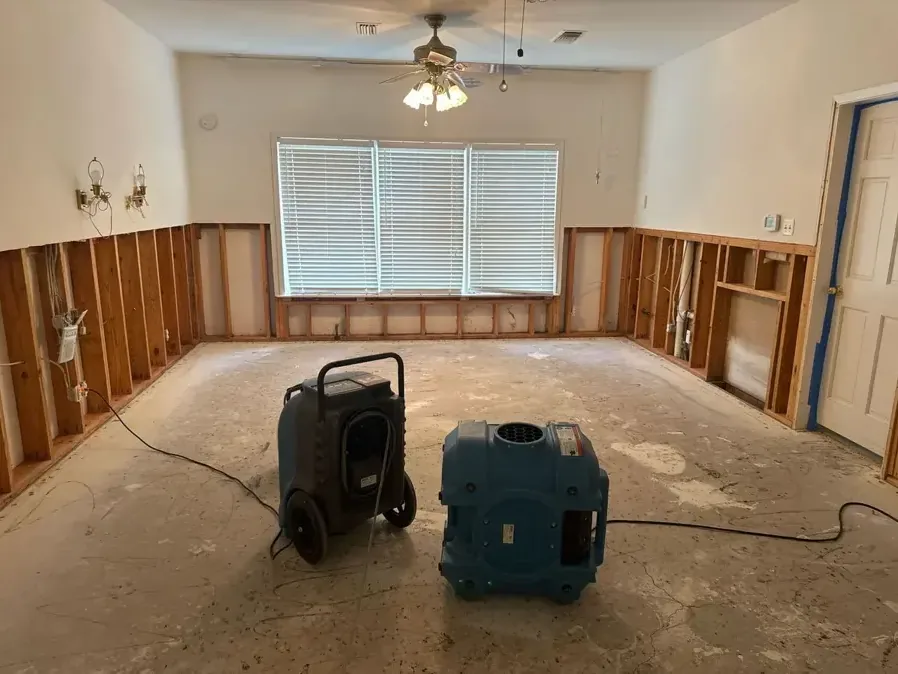
First steps for structural drying and dehumidification
- Keep the heat onWarm air dries faster, unless the furnace got wet.
- Leave equipment runningAir movers and dehumidifiers work around the clock.
- Keep doors and windows shutUnless the drying team says otherwise.
- Leave the units aloneMost pump out on their own.
How structural drying and dehumidification is handled
- 01Assess
Map
Meters and thermal imaging set the wet area.
- 02Remove
Size
Equipment matched to the class of loss.
- 03Dry
Log
Psychrometric readings every day.
- 04Verify
Verify
Equipment out at the drying goal.
The drying goal: wet materials read within 2 to 4 points of a dry reference material in the same building. Equipment leaves on readings, not on a schedule.
What does structural drying and dehumidification cost in Cottage Grove, MN?
Structural drying here typically runs $1,000 to $8,500, mostly equipment days and daily monitoring. A small Class 1 or 2 area costs the least; a Class 4 basement with block walls and slab needs more equipment for longer.
- Air movers
- LGR dehumidifier
- Daily readings
- Several air movers
- Two or more dehumidifiers
- Cavity drying
- Desiccant drying
- Added heat
- Extended monitoring
Ranges are typical, not a quote: the water category, square footage, material class and how fast drying started move the number most. Run the water damage cost calculator for a closer planning range.
Structural drying is the part of a water loss that decides whether problems come back. Drywall can feel dry while the framing behind it, the subfloor under it and the block wall beside it still hold water. IICRC S500 sets the method: measure, dry with the right equipment for the class of loss, and verify with readings.
How the drying is set up
The class of loss, from 1 to 4, sets how much equipment a room needs. Class 1 is a small, low-absorption area; Class 4 means dense materials such as hardwood, plaster, block and concrete that need long, targeted drying. The crew sizes air movers to the wet surfaces and dehumidifiers to the room volume.
- LGR dehumidifiers for most rooms
- Desiccant units for cold basements and dense materials
- Injection drying for wall cavities and under cabinets
- Heat added when a lower level is too cool to dry well
Readings decide when it is done
Drying always follows water extraction. Every visit, the drying team records temperature, relative humidity and grains per pound in the room and outside it, plus moisture readings on each wet material. Equipment comes out when wet materials read within 2 to 4 points of a dry reference material in the same building, and those logs go into the insurance claim file.
Why basements here take longer
Lower levels on cinder-block foundations hold water in the block cores, and cool basement air slows evaporation. University of Minnesota Extension publishes home moisture information for Minnesota households, and the EPA WaterSense program explains how to catch leaks before they need a full dry-out.
Structural drying and dehumidification across the city and the east metro
The restoration team covers ZIP 55016 end to end, from Old Cottage Grove and Langdon to the Thompson Grove ramblers west of Highway 61, River Acres and Grey Cloud Island on the Mississippi, and the newer streets off Ravine Parkway in East Ravine.
Nearby coverage reaches Woodbury, Inver Grove Heights, Hastings, Rosemount, Mendota Heights.
Structural Drying and Dehumidification questions in Cottage Grove, MN
How long does structural drying take?
Most rooms dry in three to five days. Class 4 materials such as hardwood, plaster, block and concrete can take seven days or more.
Why do the drying machines have to run all the time?
Drying works by moving and removing moist air without a break. Turning equipment off lets moisture settle back into materials and adds days.
What does 2 to 4 points of a dry reference mean?
The crew measures a dry, unaffected material of the same type in the building. Wet materials are dry when they read within 2 to 4 points of it.
What is the difference between LGR and desiccant dehumidifiers?
LGR units work well at normal room temperatures. Desiccant units pull moisture in cold or very dry conditions and from dense materials such as concrete.
Is the noise and power use normal during structural drying?
Yes. Air movers are loud and the equipment draws steady power for a few days. The drying team spreads units across circuits.
What does structural drying cost?
Usually $1,000 to $8,500, depending on the class of loss, the number of rooms and how many days the equipment runs.
Still dealing with it?
Moisture mapping, equipment sized to the class of loss and daily logs until the structure is dry, at any hour.
Dry is a number, not a feeling. Get the readings.
Moisture mapping, equipment sized to the class of loss and daily logs until the structure is dry, at any hour.