Structural Drying and Dehumidification in Mendota Heights, MN
After the water is extracted, wet framing, subfloor and walls are dried on a monitored plan. Equipment is placed by readings, adjusted at each visit and removed only when the structure reaches normal levels.
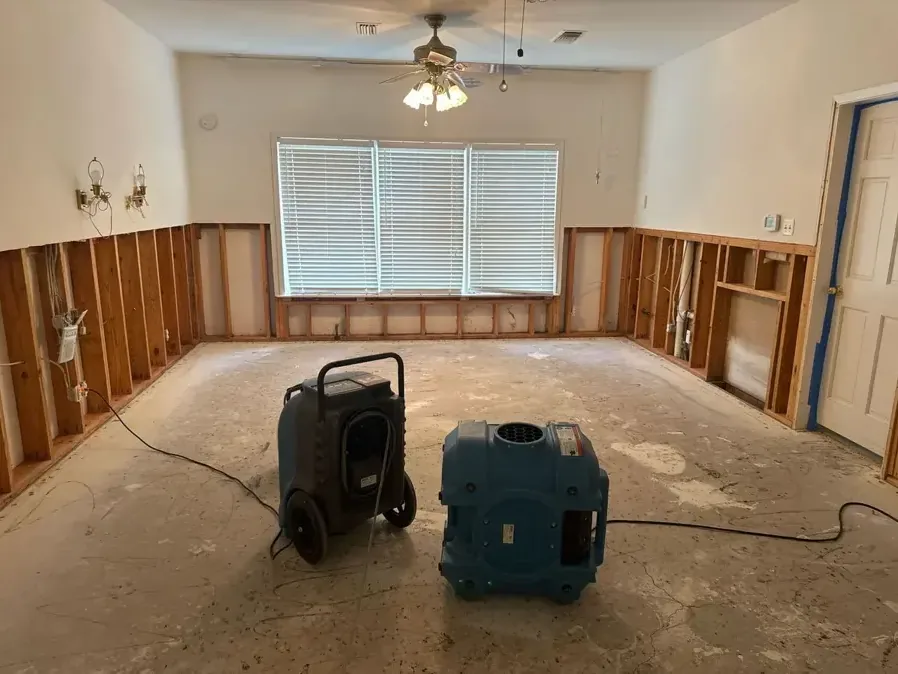
First steps for structural drying and dehumidification
- Map the wet areaA meter charts every wet wall, floor and ceiling surface.
- Place the equipmentAir movers and dehumidifiers are set where the readings are highest.
- Recheck and adjustReadings are repeated and the equipment is moved to match.
- Confirm and removeEquipment leaves only when materials reach normal levels.
How structural drying and dehumidification is handled
- 01Assess
Map
A meter charts the wet surfaces.
- 02Remove
Place
Equipment goes where readings run highest.
- 03Dry
Adjust
Readings steer each change at the next visit.
- 04Verify
Finish
The structure reads normal before equipment leaves.
The drying goal: wet materials read within 2 to 4 points of a dry reference material in the same building. Equipment leaves on readings, not on a schedule.
What does structural drying and dehumidification cost in Mendota Heights, MN?
A small area of Class 1 to 2 drying usually costs $1,000 to $2,500. A full room or level runs $2,500 to $5,500, and a Class 4 basement with dense, deeply wet materials costs $4,500 to $8,500.
- Few air movers
- One dehumidifier
- Short monitoring
- More air movers
- Several readings
- Walls checked
- Dense materials
- Specialty drying
- Extended monitoring
Ranges are typical, not a quote: the water category, square footage, material class and how fast drying started move the number most. Run the water damage cost calculator for a closer planning range.
Extraction removes the water that can be seen. Drying removes the moisture that cannot, the water held inside framing, subfloor, drywall and concrete. Skipping that second step is how a clean looking room turns into a swollen floor and a stained wall a few weeks later.
How the plan is built
- The wet area is mapped with a meter and written down.
- Air movers push dry air across the wet surfaces.
- Dehumidifiers pull moisture out of the room air.
- Readings are repeated at each visit and equipment is shifted to match.
The plan changes as the materials dry, which is why a fixed number of days never describes a job. Concrete and framing release water slowly, while drywall and carpet give it up quickly. That difference is why a room can read dry in one spot and wet a short distance away, and why readings are taken in several places.
Classes of damage
The price cards use drying classes, from small areas of Class 1 to 2 up to a Class 4 basement where dense materials hold water deeply. A higher class means more equipment, more visits and a longer dry time, even when the surface water volume was similar.
Where drying fits
Drying follows every other water job: water extraction comes first, and flooded levels also involve basement flooding cleanup. Sewage jobs reach this step only after sanitary cleaning, and roof or pipe leaks end here too.
Structural drying and dehumidification across Mendota Heights and nearby communities
Structural drying serves ZIP codes 55118 and 55120 across the city, from homes off Victoria Curve and Lexington Avenue to those near Interstate 494, Minnesota Highway 55 and Centre Point Boulevard, wherever materials are still wet.
The same service nearby: structural drying and dehumidification in Cottage Grove, Inver Grove Heights, Rosemount.
Water damage restoration in Mendota Heights · every town covered
Structural Drying and Dehumidification questions in Mendota Heights, MN
What is structural drying?
It is the drying of framing, subfloor, drywall and concrete after the visible water is gone, using air movers and dehumidifiers tracked by meter readings.
How long does structural drying take?
It depends on the materials, the amount of water and the weather in the house, so no fixed schedule applies. Equipment stays until repeated readings stop dropping.
Why do dehumidifiers run along with air movers?
Air movers lift moisture off surfaces and dehumidifiers take it out of the air. Running one without the other leaves the moisture in the room.
What do the drying classes mean?
They describe how much water the materials hold and how fast it can leave, from small areas at Class 1 to 2 to dense deeply wet materials at Class 4.
Does drying cost more than extraction?
Often yes, because it needs equipment for longer. Small areas run $1,000 to $2,500, a full room or level $2,500 to $5,500, and a Class 4 basement $4,500 to $8,500.
Can drying start before the leak is repaired?
It can start once the water source is closed. Drying while the supply still runs only feeds the wet area.
Still dealing with it?
A call sets up the mapping, the equipment layout and the follow up readings.
Dry to the touch is not dry to the meter
A call sets up the mapping, the equipment layout and the follow up readings.